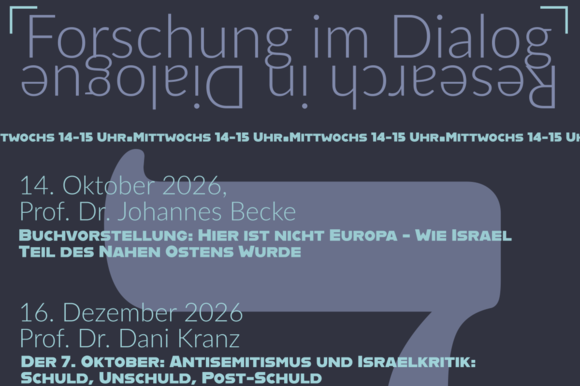

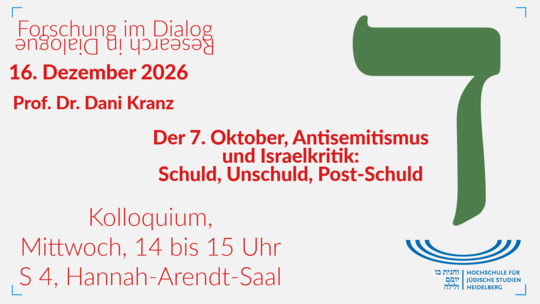
Research Colloquium: October 7, Anti-Semitism and Criticism of Israel ...
How has Germany dealt with the memory of the Nazi era since 1945, and whose experiences are included in that narrative? This question will be discussed using the examples of Israeli and Jewish communities, as well as Palestinian and Muslim communities.
A key concept here is “agnotology.” This refers to the ignorance that a society itself generates, for example by remaining silent on certain topics. This concept helps illustrate what is being silenced in the handling of the Nazi past and what consequences this has for these minorities. Moreover, German remembrance culture is anything but uniform. It is influenced by family histories as well as by approaches that critically examine the consequences of colonialism, and the Israeli-Palestinian conflict further complicates it.
Since the Hamas massacre on October 7, 2023, tensions within society have become particularly evident. There is also critical scrutiny of how Germany commemorates the Holocaust and how it engages with Jewish and Israeli as well as Muslim and Palestinian communities in the process. Their memories often do not fit into the prevailing national narrative of history. Linked to this is the goal of replacing ideologically charged debates with empirical research, thereby contributing to an understanding of the politics of memory that is based on facts and promotes social harmony.
Prof. Dr. Dani Kranz holds the visiting professorship of the non-profit Hertie Foundation.
-
 Date 16 December 2026
 -
 Time 14:00 - 15:00 UTC+01:00
 -
 Participation On-site
 -
 Language German
 -
 Contact HfJS
 -
 Location Hannah Arendt Hall, S4 (HfJS Heidelberg)
 -
Registration? No