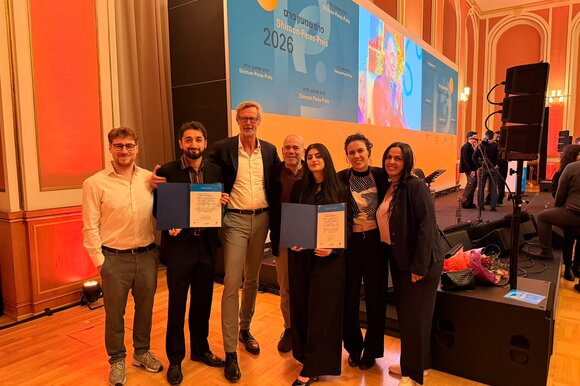
Who We Are

  • Office Hours: Martha Fiedelak

  • Representative on the Senate: Martha Fiedelak (Alternate: Liel Pushkin)

  • Representative on the Examination Committee: Shushan Pushkin (Alternate: Evelyn Neyer)

  • Representative on the Library Committee: Evelyn Neyer (Alternate: Shushan Pushkin)

  • Events: Liel Pushkin, Shushan Pushkin, Evelyn Neyer, Ronja Bilger, Martha Fiedelak, Raphael Novik, Hanna Kiskina, and Karin Graf

  • Press & Partnerships: Evelyn Neyer, Shushan Pushkin

  • International Student & Networking Coordinator: Evelyn Neyer, Martha Fiedelak

You can find us in Room N1.14, the last door on the right before the entrance to S4

Feel free to check us out on Instagram or contact us by email


What we do

  • Consultation hours for students
  • Representation of students vis-à-vis lecturers and other staff in the building
  • regular student Shabbat with the university rabbi
  • joint celebration of Jewish festivals
    (e.g. lighting the Hanukkah candles)
  • Regulars' table with the Rector of the HfJS

The election of the student representatives takes place every winter semester in the first month of the beginning of the semester as part of a general student assembly.

Your student representatives of the HfJS

Events organized by the Student Union

No news available.

Past events

The Forgotten Years: Jewish Life in Tunisia Under the Vichy Regime and German Occupation, 1940–1943

News

Our podcast guest is Dr. Imen Ben-Temelliste, a historian and research associate in the project “Jewish World Heritage—Local Jewish Heritage in Germany” at the chair of Prof. Dr. Johannes Heil. She is also involved in political education efforts at the Heidelberg Muslim Academy, which is currently being established.

The conversation focuses on her dissertation, “The Forgotten Years,” which examines the history of Tunisia’s Jewish community during the Vichy and Nazi regimes from 1940 to 1943. Imen Ben-Temelliste sheds light on a history that is often barely visible in the public consciousness: persecution and discrimination, the differing experiences of the Twānsa and Grāna communities, forms of resistance and self-assertion, as well as the long-term consequences for the relationship between Tunisian Jews and their homeland.

This episode shows that the history of the Shoah was not limited to Europe—and that the history of Tunisia’s Jewish community is an integral part of the country’s history.

Listen to the episode “ ” (Spotify)

Listen to the podcast “ ” (Podcast.de)
Jüdische Studien Heute Logo
  • Date: 16 November 2026
    Date 16 November 2026
  • Time: 
	07:26
	UTC+01:00
    Time 07:26 UTC+01:00
  • Participation:
    Participation
  • Language:
    Language
  • Contact:
    Contact
  • Location:
    Location
  • Registration? No

News