

Equality Plan of the HfJS
* Please note that the following text is a non-binding convenience translation. Only the German version of the document has legal validity.*
According to Article 3 (2) of our Basic Law, men and women have equal rights. In implementing this constitutional requirement, universities are obliged to promote the effective enforcement of equal rights for women and men and to eliminate any existing disadvantages.
The equality plan is one of the central instruments for promoting equality between women and men and a better work-life balance for women and men. The Heidelberg University of Jewish Studies (HfJS) also sees itself as a cosmopolitan place of learning, teaching, and working in general. Therefore, it is a declared goal to raise awareness among all university members of the various categories of inequality, to create an overall diversity-sensitive and appreciative environment across all status groups, and, where necessary, to develop measures to prevent discrimination and exclusion of any kind.
The Heidelberg University of Jewish Studies sees the achievement of gender equality as a central cross-cutting task that affects every area of work. For the university, equality means creating a non-discriminatory academic environment and ensuring equal opportunities regardless of gender, nationality, ethnic and social origin, religion, ideology, age, or sexual orientation.
The university's equality plan was approved by the Rector on March 6, 2025. It is regularly updated by the Rector in collaboration with the equal opportunities officer.
The equality plan contains an analysis of the current situation, from which goals and measures for achieving equality have been derived and which are to be implemented in the coming years.
Contents
1. Studies/Students
1.1 Inventory and Analysis
1.2 Goals
1.3 Measures
2. Academic Staff
2.1 Inventory and Analysis
2.2 Goals
2.3 Measures
3. Doctorates since 2014
3.1 Inventory and Analysis
3.2 Goals
3.3 Measures
4. Staffing and Appointments to Professorships
4.1 Inventory and Analysis
4.2 Goals
4.3 Measures
5. Non-academic Employees in Administration and Support Areas
5.1 Inventory and Analysis (cut-off date: December 1)
5.2. Goals
5.3 Measures
6. Gender-sensitive Communication
7. Personnel Development
8. Compatibility of Studies or Career and Family
8.1 Compatibility of Studies and Family
8.2 Work-Life Balance
9. Measures against gender-based Violence, including sexual Harassment and Violence
10. Final Provisions

1.2 Goals
Given that women make up the majority of students, female students are adequately represented. There is no discrimination.
1.3 Measures
However, it should be noted that the proportion of women declining. The university is monitoring this development and will take countermeasures in good time if necessary, such as increased advertising of the degree programs to potential female students.
2. Academic staff
2.1 Inventory and Analysis
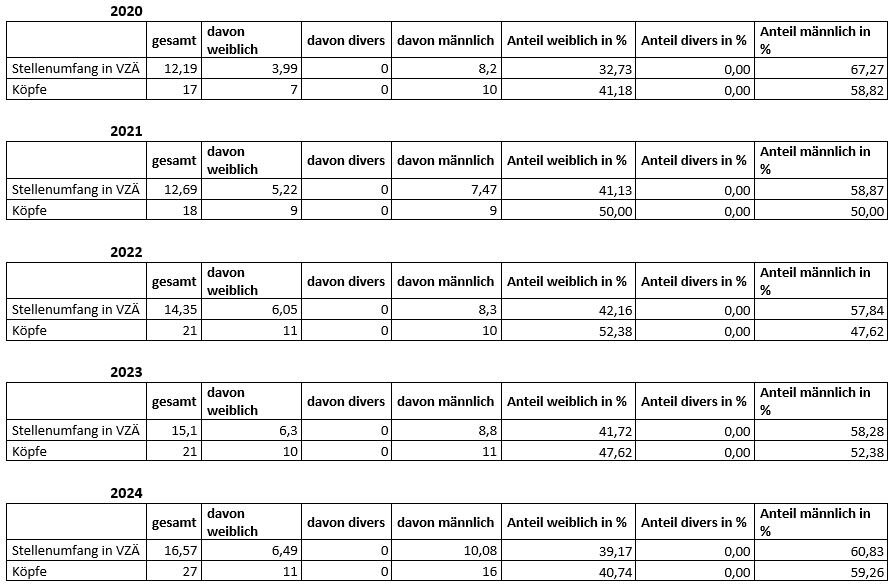

Women are adequately represented among academic staff. There is no discrimination.
2.2 Goals
The HfJS aims to have female academic staff make up 50% of the total number of full-time equivalent positions.
2.3 Measures
To achieve this goal, the faculty should be made aware that female academic staff are underrepresented and should be given preference in hiring when equally qualified. Suitable female students should be encouraged to apply for academic staff positions toward the end of their studies.
In addition, vacant positions will generally be advertised and the requirements of the AGG will be implemented. The advertisement will not contain any gender-specific restrictions.
Application documents are to be reviewed using transparent and gender-neutral evaluation criteria. Documentation of this is recommended.
The selection committee should be composed of equal numbers of men and women, where possible, and should be gender-competent.
The entire process should be characterized by respectful and continuous communication with all applicants.
Many scientific employees are employed on a part-time basis. They should therefore be informed that they have the same opportunities to participate in training courses as full-time employees. Employees are released from work to participate in training courses and travel and participation costs are covered.
When projects are extended, it must always be checked whether the employees can be taken on.
3. Doctorates since 2014
3.1 Inventory and Analysis
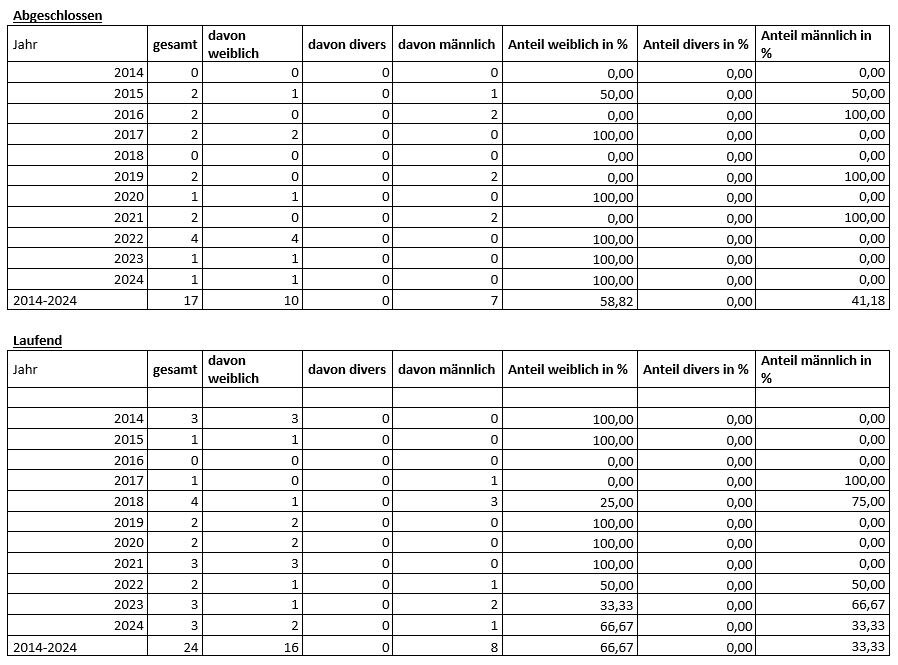
Women are adequately represented in both completed and ongoing doctoral programs. There is no discrimination.
3.2 Goals
The goal is to maintain this positive result.
3.3 Measures
No measures are currently necessary. The university will review the figures regularly and react immediately if there is a downward trend.
4. Staffing and Appointments to Professorships
4.1 Inventory and Analysis
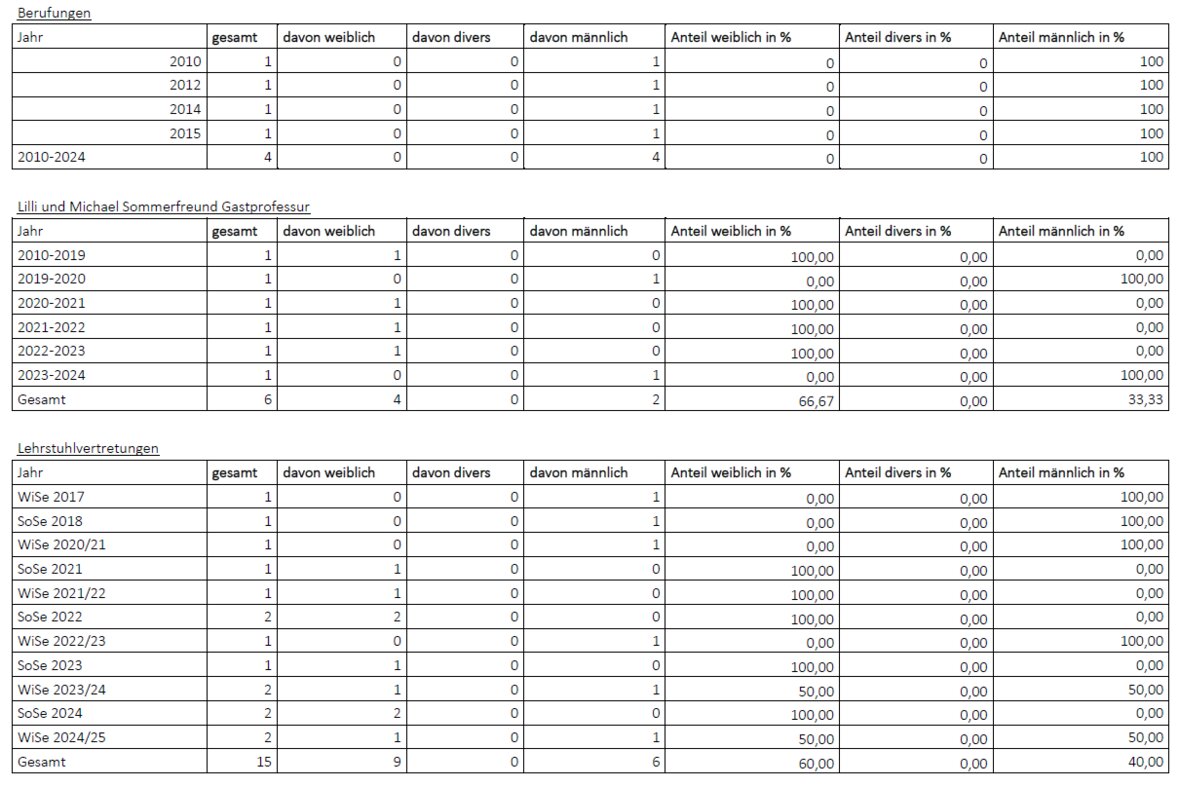
The proportion of women among appointments is 0%, whereas women make up the majority of Lilli and Michael visiting professors (66.65%) and chair substitutes (59.4%).
4.2 Goals
The goal is to significantly increase the proportion of women in appointments.
4.3 Measures
The measures cover all phases of the appointment process. However, the job advertisement plays a particularly important role. Care is taken to ensure that it does not contain any gender-specific restrictions and that people of all genders feel addressed. In addition, it is expressly stated that applications from women are particularly welcome. Furthermore, the members of the appointment or selection committee should be gender-competent and, if possible, the committee should be composed of equal numbers of men and women. The appointment procedure should begin with an analysis aimed at identifying women with proven professional expertise and providing them with specific information about the vacancy. Professorships and substitute professorships, should, as far as professionally possible, be awarded to women as a matter of principle. Gender competencies for teaching, studying, and continuing education should be anchored in the profiles and job advertisements. The appointment procedure should ensure appreciative and continuous communication with all applicants. The evaluation criteria for the application documents must be formulated in a transparent and gender-neutral manner.
5. Non-academic Employees in Administration and Support Areas
5.1 Inventory and Analysis (cut-off date: December 1)
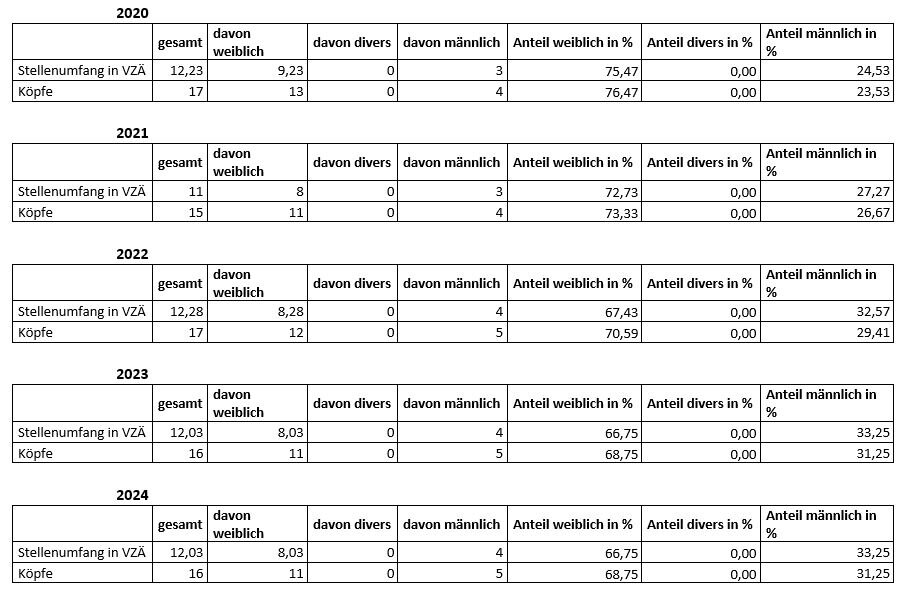
Women are adequately represented among non-academic staff. There is no discrimination.
5.2. Goals
The goal is to maintain this positive result.
5.3 Measures
Vacant positions are always advertised. Even at the job advertisement stage, care is taken to ensure that these do not contain any gender-specific restrictions and that people of all genders feel addressed. In addition, it is expressly stated that applications from women are particularly welcome. The positions are also advertised as part-time, provided that this does not conflict with compelling operational requirements. The selection process complies with and implements the requirements of the AGG. This means that female applicants with equivalent qualifications, skills, and professional performance are given preferential consideration, unless reasons relating to a male competitor outweigh this. In addition, the selection committee for the selection interviews should be composed of equal numbers of men and women, where possible, and should be gender-competent. The entire process should be characterized by respectful and continuous communication with all applicants.
Regular employee appraisals are conducted for all administrative staff. These offer both the opportunity to express a desire for personal development and the opportunity for the university to find out about these wishes, identify the resources and potential of individual employees, keep track of them, and promote and enable further development. Training opportunities are available at the University of Heidelberg and from other external providers. Part-time employees have the same opportunities to participate in training as full-time employees. Employees are granted leave from work to participate in training courses, and travel and participation costs are covered.
6. Gender-sensitive Communication
The university strives to use gender-neutral language in its internal and external communications in order to promote awareness. Various forms of gender-sensitive language are used among employees: in addition to gender-neutral terms and the feminine and masculine forms of language, the so-called gender star (*) and gender colon are also used. The university strives to establish gender-sensitive language that takes into account a person's social gender. The aim is to represent men, women, trans* persons, and inter* persons in their diversity of gender identities in an appropriate and equal manner.
7. Personnel Development
The university's goal is to enable all employees to pursue professional development and participate in training events on an equal basis. Employees have the opportunity to participate in training courses offered by the University of Heidelberg as well as training courses offered by external providers.
Part-time employees have the same opportunities to participate in continuing education as full-time employees.
The university strives to promote gender competence among its employees. To achieve this, they can and should complete continuing education courses that aim to develop and/or expand gender competence and sensitize them to gender-specific issues.
8. Compatibility of Studies or Career and Family
8.1 Compatibility of Studies and Family
The university supports students who care for and raise children in completing their studies as smoothly as possible despite the accompanying family challenges. To this end, the University of Heidelberg offers services to students with children to help them balance their studies and family life.
Courses at the university are generally held at family-friendly times.
In addition, the Master of Education program can be completed on a part-time basis. This option will be extended to other programs.
8.2 Work-Life Balance
The university offers a wide range of individual options to help employees balance work and family life.
The university has set itself the goal of further strengthening the compatibility of family and career. To this end, the existing options are constantly reviewed and further developed. In addition, individual solutions are implemented where necessary and possible.
Numerous measures are being taken to improve the compatibility of work and family life.
Part-time work is possible in all areas of responsibility. The aim is to align employees' working hours with their individual needs within the framework of the legal possibilities.
All part-time employees are given the same career advancement and training opportunities as full-time employees. Periods of childcare, family work, and part-time employment are not considered a disadvantage when assessing qualifications.
The university strongly supports the use of parental leave and leave of absence for family work, including by male employees.
Since the outbreak of the coronavirus pandemic, all employees whose work organization allows it have had the option of working remotely once a week, which has further strengthened the compatibility of work and family life.
Committee meetings and regular meetings are family-friendly and, where possible, take place during working hours when part-time employees are also present. When arranging short-term task- or project-related appointments within the individual departments, individually agreed part-time working hours are also taken into account.
9. Measures against gender-based Violence, including sexual Harassment and Violence
Finally, it is of paramount importance for the university to ensure a working environment in which every person feels safe. Among other things, this means providing tools to combat gender-based violence, in particular sexual harassment.
According to Section 3 (4) AGG, sexual harassment occurs when unwanted, sexually determined behavior, including unwanted sexual acts and requests for such acts, sexually determined physical contact, remarks of a sexual nature, and the unwanted display and visible posting of pornographic images, has the purpose or effect of violating the dignity of the person concerned, in particular when an environment of intimidation, hostility, humiliation, degradation, or insult is created.
The university should be a safe and non-violent place to study, teach, and work, where no form of sexual harassment, discrimination, or violence is tolerated. To this end, the following measures are taken:
The university management shall ensure that supervisors and other responsible persons are informed of their obligations to protect employees and students and that they fulfill these obligations.
On March 5, 2025, the university senate adopted the Senate Guideline on Cooperative Behavior, which ensures that the university guarantees equal and respectful treatment of its members and affiliates at all functional levels. All members and affiliates of the university, especially those with teaching and management responsibilities, must take appropriate measures in their area of work to prevent sexually discriminatory behavior, harassment, and violence. They are obliged to follow up on every report within the scope of their responsibility, take concrete measures, and make full use of their legal and practical options.
The points of contact for help with sexual harassment and violence are the respective supervisors of the person concerned and the contact person for sexual harassment and anti-discrimination. In addition, supervisors and those affected can also contact the equal opportunities officer. Affected students can also contact the university's equal opportunities officer and the contact person for sexual harassment and anti-discrimination.
10. Final Provisions
The equality plan shall enter into force upon its publication on the website.
Dr. Andreas Brämer
Rector of the HfJS