
Max Reschke
(January 28, 1894, Berlin – August 30, 1964, Berlin)
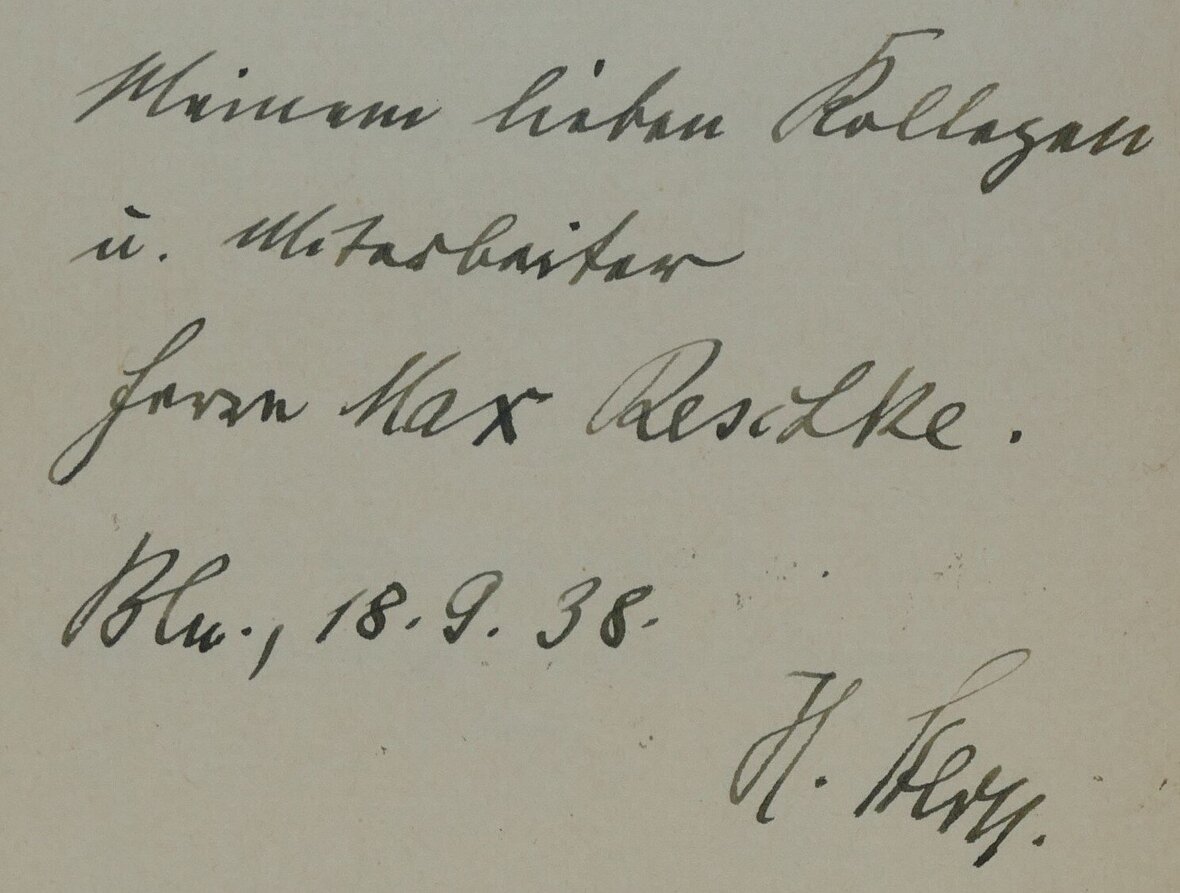
In April 2026, Max Reschke’s grandson contacted the HfJS after noticing the dedication to his grandfather published in the “Looted Cultural Assets” database:
To my dear colleague and co-worker, Mr. Max Reschke.
Berlin, Sept. 18, 1938.
H. Stern. (transl.)
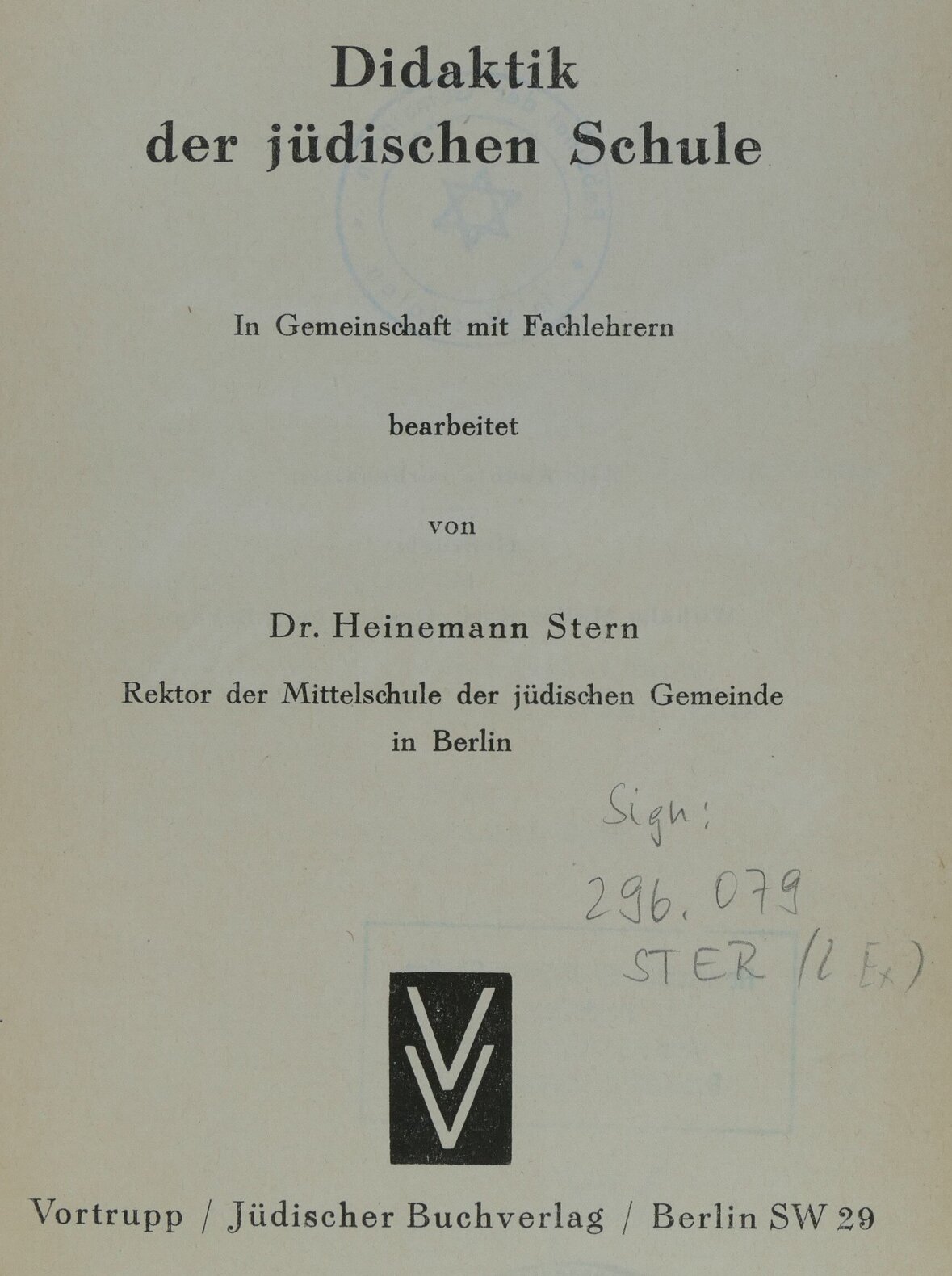
The book containing this dedication has been part of the Albert Einstein Library’s collection since 1988 and was identified as suspected Nazi-looted property and published as such.
The dedication was written by the author himself. He is Dr. Heinemann Stern, born in 1878 in Nordeck, Hesse. Stern was a teacher at the Jewish Middle School in Berlin and became the school’s principal in the early 1930s. In 1940, he managed to emigrate to Brazil, where he died in 1957.
His “Didaktik der jüdischen Schule” (“Didactics of the Jewish School”) was published in 1938 in collaboration with colleagues and was the first treatise on this topic since the Nazis came to power. The publication was supported by the Reich Representation of Jews in Germany and the Prussian State Association of Jewish Communities and addressed the increasingly difficult circumstances of educating Jewish children. The lesson plan described in the chapter “Palestine Studies” reflects the virtually unavoidable direction taken by Jewish educational institutions.
Max Reschke, born in Berlin in 1896, was the principal of the Jewish Elementary School, which was founded in 1927 and was located on the premises of the middle school headed by Stern (Große Hamburger Straße 27, later Kaiserstraße 29/30). He was thus Stern’s colleague and received the book as a gift from him, with a dedication.
A year earlier, Max Reschke had married Hanny/Johanna Caro, who was also born in Berlin. Their son, Wilfred, was born in 1930.
After the school was forcibly closed in 1942, Reschke worked for the Reich Representation of Jews in Germany. Beginning in 1943, he served as a guard and later as director of the assembly and detention camps on Große Hamburger Straße and Iranische Straße in Berlin.
This position protected him and parts of his family from deportation, but led to his arrest after the war ended; without a court verdict, he was initially imprisoned for five years in various camps, including Special Camp No. 2 Buchenwald in the Soviet Occupation Zone and the GDR. Another five years of imprisonment in the GDR followed as a result of a conviction in the Waldheim Trials. Leo Baeck sought—possibly successfully—an early release from detention. In 1955, Reschke was exonerated by the Jewish Community’s Court of Honor. He died in 1964 in Berlin-Schmargendorf.
Like Reschke’s wife Johanna, his son Wilfred also survived the Shoah in Germany. After the war ended, Wilfred Reschke spent several months in a UNRRA camp before presumably emigrating to what was then Palestine as part of the Youth Aliyah. After his father’s release from prison, he returned to the Federal Republic of Germany.
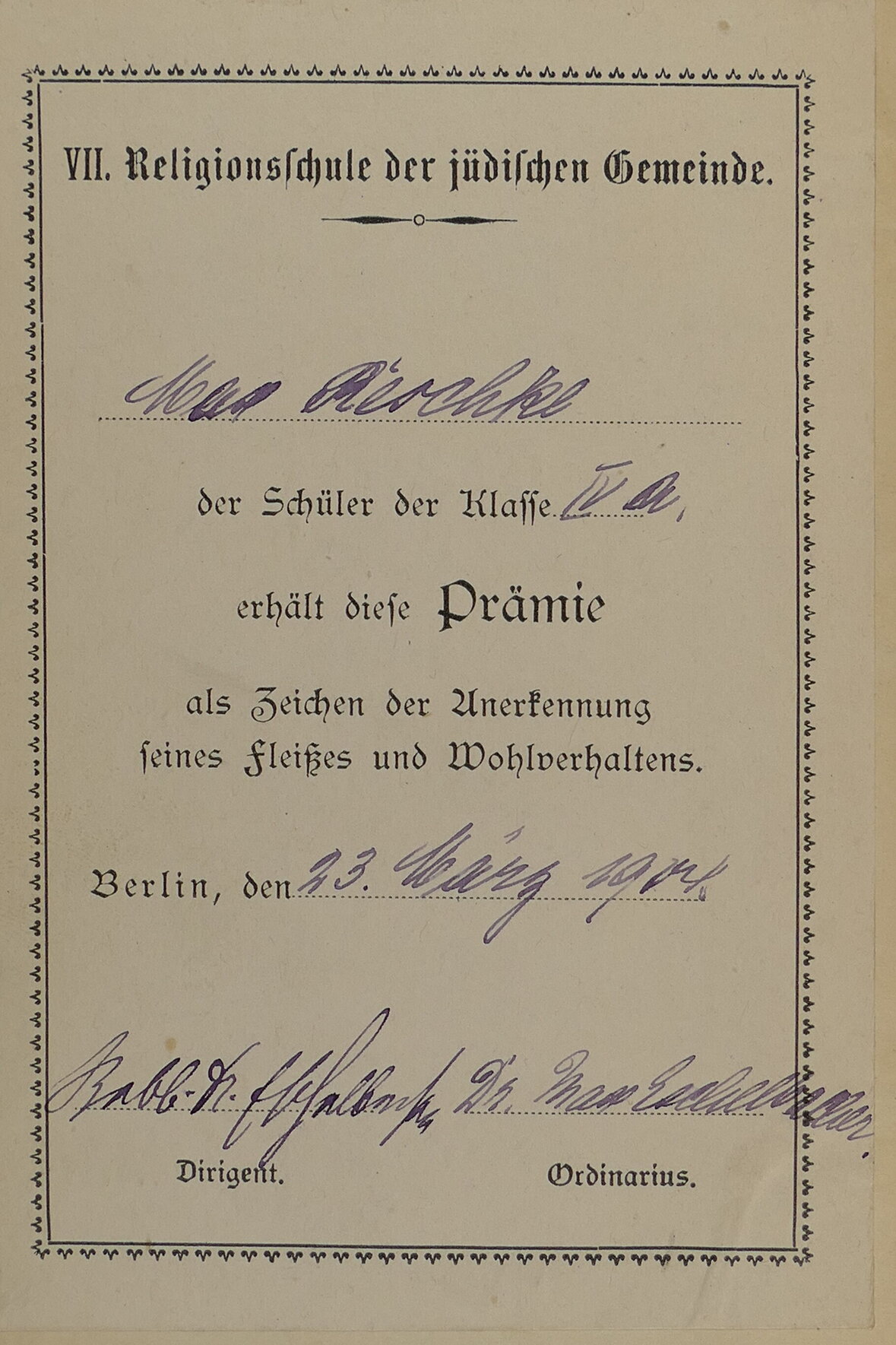
Shortly after the book was returned to the family, another book was identified in the HfJS storage facility as belonging to Max Reschke: "Hebräische Gesänge" ("Hebrew Songs") by Moriz Rappaport. Reschke had received this book as early as 1904 as a reward for good performance in school. From the pasted-in dedication label, we know that Reschke had attended the VII. Religious School of the Jewish Community of Berlin. This school was founded in 1901 and was located at Annenstraße 1b. When Reschke was in the 4th grade—at the end of which he received the book—approximately 300 students attended the school. At that time, it was headed by Rabbi Dr. Josef Eschelbacher (1848–1916), whose signature appears on the certificate of commendation. The second signature is that of his son, Dr. Max Eschelbacher (1880–1964), who was Max Reschke’s teacher.
At the time of Max Reschke’s birth, his parents—the merchant Wolf Reschke and his wife Hulda Reschke, née Kasse—were registered at the address An der Stralauer Brücke 6. The building, which no longer exists, was located between the former Waisenbrücke and the Jannowitzbrücke on what is now Rolandsufer. Reschke had to cross one of these two bridges to get to the VII. Religious School. Right in front of the house was one of the popular Spree river swimming spots where Max Reschke had learned to swim—according to the account of his son Wilfred (1930–2020).
Acknowledgments:
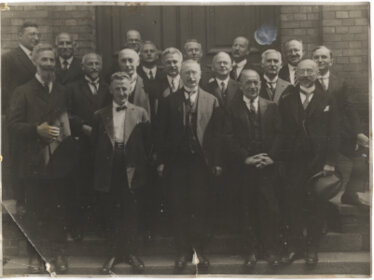
We would like to thank Max Reschke’s grandson for his trusting cooperation in shedding light on Max Reschke’s biography, as well as for allowing us to publish family photographs here. We would also like to thank the staff at the Hessian State Archives in Marburg for their kind assistance regarding Heinemann Stern.
Selected Sources and Bibliography:
- Weigelt, Andreas: „Umschulungslager existieren nicht“. Zur Geschichte des sowjetischen Speziallagers Nr. 6 in Jamlitz 1945-1947, Brandenburgische Historische Hefte 16, Potsdam 2001, S. 157-159 (see https://www.politischebildungbrandenburg.de/system/files/downloads/umschulungslager.pdf)
- Mention of Reschke in Berlin’s Jewish community institutions in the Jewish Address Book for Greater Berlin 1931/32: https://digital.zlb.de/viewer/image/34039536_1931_1932/27/LOG_0011/
- Birth certificate of Max Reschke (son of Wolf Reschke and Hulda Reschke, née Kasse): Ancestry
- Death record for Max Reschke: Ancestry
- Birth of Johanna Caro and registration of victims of Nazi persecution after liberation: Ancestry
- Records on Max Reschke in the Federal Archives: Central Legal Protection Office (criminal trial file): B 305/13704, Federal Office of Administration (widow Johanna Reschke): B 311/41243 and B 311/41244, Reich Association of Jews in Germany: R 8150/63), Ministry of the Interior (personnel file): DO 1/110814, Ministry of Justice (index card file): DP 1/30330, Ministry of the Interior (personnel file): DO 1/2240.
- Questionnaires and witness statements regarding Max Reschke in the holdings of the Vienna Holocaust Library
- Handover protocol for Albert Wendt-Wechsler regarding the compulsory surrender, countersigned by Max Reschke; see https://blha-recherche.brandenburg.de/de/#/details/viewer/2013729?selectedId=2013729 (Scan 73)
- Max Reschke and other fellow teachers on the front lines during World War I: https://sammlungen.ub.uni-frankfurt.de/cm/periodical/pageview/11326459?query=%22max%20reschke%22
- Engagement of Max Reschke and Johanna/Hanny Caro on July 1, 1926: https://sammlungen.ub.uni-frankfurt.de/cm/periodical/pageview/11335003?query=%22max%20reschke%22 (Johanna/Hanny Caro was the daughter of Francis Caro and Mathilde Caro, née Lipschütz/Lipschitz.)
- Führer durch die jüdische Gemeindeverwaltung und Wohlfahrtspflege in Deutschland 1932-33, S. 513, herausgegeben von der Zentralwohlfahrtsstelle der deutschen Juden, bearbeitet von Dr. Bella Schlesinger (vgl. https://sammlungen.ub.uni-frankfurt.de/cm/periodical/pageview/84248?query=%22max%20reschke%22
- Article by Max Reschke in the “Jüdische Schulzeitung” dated December 1, 1935, pp. 4–6; Report on the new challenges facing Jewish school education, discussed at two conferences in Würzburg and Leipzig; see https://sammlungen.ub.uni-frankfurt.de/cm/periodical/pageview/2826695 ff.
- Son Wilfred Reschke (known as Daniel Reschke in Palestine/Israel): Index of the Reich Association of German Jews: https://collections.arolsen-archives.org/de/document/12669607 and https://collections.arolsen-archives.org/de/document/12669606
- Transport of Jewish children from Berlin to Paris on November 3, 1945, including Wilfred Reschke: Ancestry
- Birth certificate of Wilfred Reschke: Ancestry
- „Kinder deutscher Herkunft in UNNRA-Lagern in Deutschland“, in: „Aufbau“ vom 30.08.1946, S. 27 (vgl. https://archive.org/details/aufbau1219461946germ/page/n710/mode/1up?view=theater)
- Regarding the person to whom the book was dedicated, Heinemann Stern: Entry in the University of Hamburg’s student registry portal, see https://www.matrikelportal.uni-hamburg.de/receive/matrikelhh_person_00010988
- Eva Rohland: "Assimilation oder Katastrophe": Das Wirken des Pädagogen Heinemann Sterns für den Centralverein im Spiegel seiner Erinnerungen, in: Rebekka Denz und Tilmann Gempp-Friedrich (Eds..): Centralverein deutscher Staatsbürger jüdischen Glaubens. Anwalt zwischen Deutschtum und Judentum, Berlin / Boston 2021.
- Heinemann Stern: Jugenderinnerungen aus Nordeck [mit Genehmigung der Tochter des Autors in Israel sowie des Verlags in Düsseldorf, ausgewählt von A. Höck], o.O., o.J. [12 pages], Hessisches Staatsarchiv Marburg, Sign. KLS X 17.
- Aubrey Pomerance u.a. (Eds.): Heinemann Stern. Jüdische Jugend im Umbruch. Briefe nach Berlin und Rio de Janeiro 1937-1953, Berlin 2019.
- Heinemann Stern: Warum hassen sie uns eigentlich? Jüdisches Leben zwischen den Kriegen. Erinnerungen, herausgegeben und kommentiert von Hans Chanoch Meyer, Düsseldorf 1970.
- For information on the VII. Religious School of the Jewish Community of Berlin, see, for example: https://sammlungen.ub.uni-frankfurt.de/cm/periodical/pageview/4829139?query=%22VII.%20religionsschule%22 and https://sammlungen.ub.uni-frankfurt.de/cm/periodical/pageview/10593826?query=%22VII.%20religious%20school%22 (Note: Some contemporary newspaper reports mention that the VII. Religious School was located on the grounds of the Rykestraße Synagogue, which was inaugurated in 1904. What is meant here is the VI. Religious School.)
Link to the book “Didaktik der jüdischen Schule” in LCA: https://db.lootedculturalassets.de/index.php/Detail/objects/254167
Link to an alternative digitized version (German National Library/German Exile Archive): https://portal.dnb.de/bookviewer/view/1032710365#page/n0/mode/2up
Link to the book “Hebräische Gesänge” in LCA: https://db.lootedculturalassets.de/index.php/Detail/objects/326418
Alternative digital copy (Library of Congress): https://archive.org/details/hebrischegesngem00rapp/page/n5/mode/2up (incidentally, this includes a dedication by the author, Dr. Moriz Rappaport, to Dr. Simon Schwabacher)
(Text: Ph. Zschommler)
Published with the kind permission of the Reschke family.
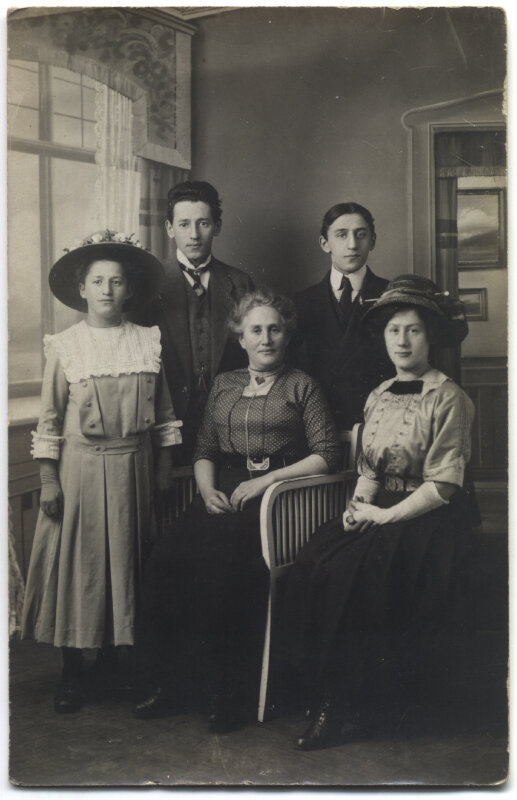
Published with the kind permission of the Reschke family.