Paris Arsenal
Journee d'etudes 2024. Foto © Ekaterina 'Qeto' Gotsiridze

Bible glossaries as hidden cultural carriers. judeo-French cultural exchange in the High Middle Ages

Funding by and establishment at the Heidelberg Academy of Sciences and Humanities / Academies' Program

Homepage | Heidelberg Academy of Sciences and Humanities

Bible glossaries as hidden carriers of culture | Heidelberg Academy of Sciences and Humanities

The project focuses on Hebrew-French glossaries, which are being edited (for the most part for the first time) and historically and philologically processed and contextualized because they are exceptional witnesses to a simultaneously developing (Jewish and Christian) French (Bible) reading culture in Western Europe between the 12th and 14th centuries. The glossaries form basic texts for research into the interrelations between Jewish intellectual history and the non-Jewish environment as well as the lexical interferences between Jewish and Christian vernacular cultures. The French glosses are written in Hebrew throughout and comprise about 1/4 of the Old French vocabulary known today.

From the outset, the philological work will be integrated into a digital working environment that uses the BIMA 2.0 database, which has been in productive use in the Corpus Masoreticum project since 2018 and is continuously being further developed. BIMA 2.0 ensures the editorial indexing and long-term archiving of all Hebrew-French material and provides tools that guarantee the sustainable management, processing, presentation and visualization of the project results. A data export interface via RDF/OntoLex ensures that the interoperability of the lexicographically relevant edition data is guaranteed as 'linked open data' with the resources of DEAFél(Dictionnaire étymologique de l'ancien français électronique), which are still available, and that DEAFél is therefore also used for further research. The field of Digital Humanities also makes an independent research contribution to the differentiation of a digital corpus linguistics of Judeo-French text cultures of the Middle Ages. The digital results will be supplemented by online and print publications that will provide new transdisciplinary academic impetus for Jewish studies, Romance studies, Jewish and Christian theology and medieval (knowledge) history as a whole.


Events

DiscussionGerman / English
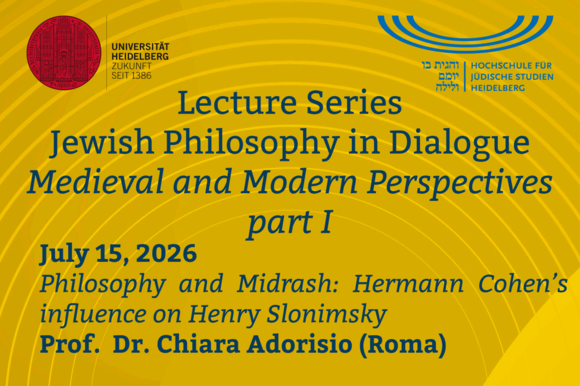
15 July - 25 November 2026 18:15 - 19:45 UTC+01:00

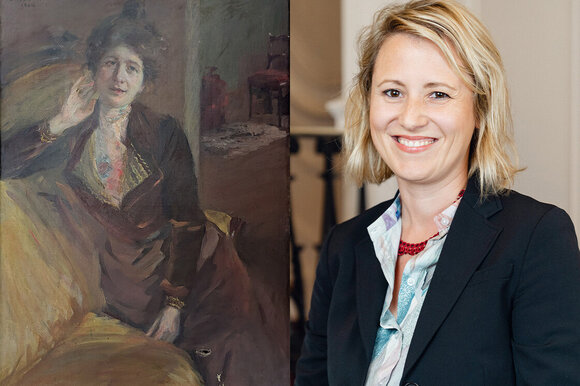
The Chair of Jewish Philosophy, headed by Prof. Michael Engel, is responsible for the new lecture series

Colorful EventOn-siteGerman
8 October 2026 19:00 - 21:00 UTC+02:00

Bucerius Art Forum

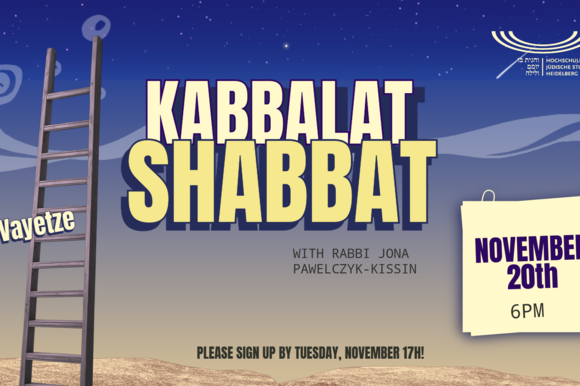
Kabbalat ShabbatOn-siteGerman
20 November 2026 18:00 - 22:00 UTC+01:00

First Shabbat celebration of the new winter semester

Past events

When a small idea from Heidelberg becomes a family program at the museum in Braunschweig

News

We’re thrilled: The Braunschweig City Museum has taken up our menorah idea and is turning it into a workshop as part of the Kulturmeile. On September 13, 2026, families can come together there to build a menorah out of interlocking building blocks—based on our idea.

Especially at a time when anti-Semitic incidents in Germany are at a high level and many Jewish people feel unsettled, we find it all the more wonderful that symbols of Judaism can be introduced in such an innocuous and playful way.

From the museum’s announcement: “How can you rediscover a millennia-old symbol using colorful building blocks? In our family workshop, we’ll build a menorah—the seven-branched candelabrum symbol of Judaism—together using LEGO bricks. The menorah is one of the oldest and most significant symbols of Judaism. It stood in the Temple in Jerusalem and to this day represents light, hope, wisdom, and community. In the workshop, young and old alike will learn about its history in a playful way—and then design their own LEGO Menorah, based on an idea from the Heidelberg University of Jewish Studies.” [Which, in turn, drew inspiration from rebrickable .]

And from the building instructions: “The menorah is a seven-branched candelabrum. Along with the Star of David, the menorah is one of the best-known and most widely used symbols of Judaism and adorns the Israeli coat of arms. … Its seven branches represent the six days of creation and Shabbat, the Jewish day of rest. … It commemorates the history of Judaism and symbolizes light, knowledge, and faith.

We thank the museum team in Braunschweig for this wonderful project and wish all participants a bright, curious afternoon! 🌟
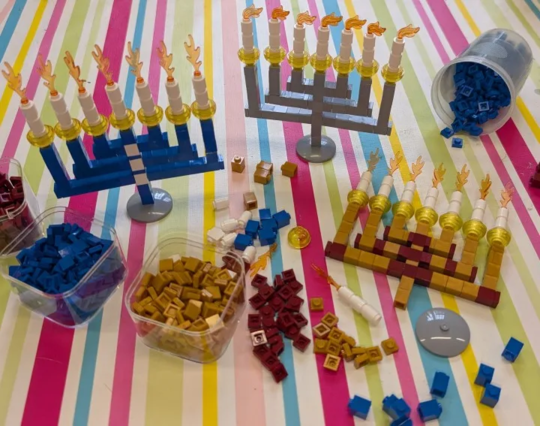
Menorot im Museum
  • Date: 10 September 2026
    Date 10 September 2026
  • Time: 
	07:46
	UTC+02:00
    Time 07:46 UTC+02:00
  • Participation:
    Participation
  • Language:
    Language
  • Contact:
    Contact
  • Location:
    Location
  • Registration? No

News

Contact us

Logo Bibelglossare blau

Bible Glossaries

Show Contact List