

What Books Reveal About Their Owners' Past
Provenance research is a bit like detective work. And the sense of accomplishment that comes from tracing a book’s origins brings real joy to those involved. This is clearly evident at the first “Lost Books Lab” at the University of Jewish Studies (HfJS) in Heidelberg. A suitcase full of old books is waiting there. They are waiting to have their origins determined so they can, if possible, be returned to the descendants of their former owners.
The books in the suitcase belonged to Jewish citizens who took them along as part of their meager belongings when they were taken by the Nazis to labor and extermination camps. Or they were part of the libraries at Jewish institutions and universities. These, too, were systematically looted during the “Third Reich” because the Nazis wanted to use them for anti-Semitic studies or needed them as evidence to support Nazi ideology, as Kinga Bloch explained at the “Lost Books Lab.” The German historian at Queen Mary University of London led the new workshops together with Philipp Zschommler, the provenance researcher at the HfJS. These workshops are funded by the Baden-Württemberg Foundation as well as by the Leo Baeck Institutes—which preserve Jewish documents, books, and memorabilia. The workshops aim to combine historical education with active research.
A precursor to these workshops was the “Library of Lost Books” exhibition two years ago, organized by the Leo Baeck Institutes in Jerusalem and London. The exhibition also featured, in Heidelberg, books from the former College for the Study of Judaism in Berlin, which are now scattered around the world. At the time, the Library’s website was honored with the Grimme Online Award.
The idea that traces of Nazi persecution can also be found on bookshelves can now be conveyed from the academic community to the general public. By Provenance Research Day in April, for example, the goal is to spark interest in the topic among companies and vocational school students. Companies? Kinga Bloch recalls forgotten connections in Baden-Württemberg: The shoe manufacturer Salamander began as a German-Jewish company. AEG, owned by Walther Rathenau’s family, once laid the first long-distance power line from Lauffen am Neckar to Frankfurt. Südzucker, with its Jewish shareholders, board members, and supervisory board members, is also part of this history. “Jewish entrepreneurs were so deeply intertwined with remarkable achievements that continue to shape our lives today.”
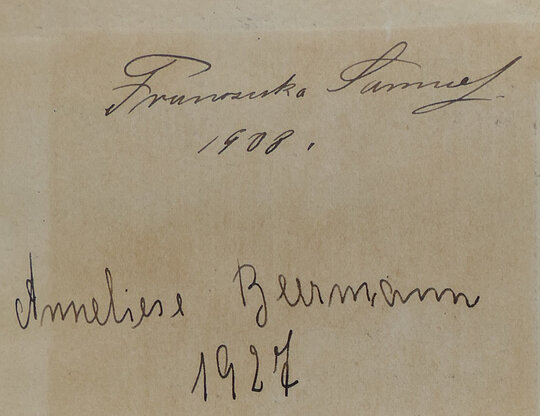
But how can we interpret the history of these books? The works from Philipp Zschommler’s suitcase bear forensic traces that can facilitate the search: stamps, stickers, personalized bookplates, and dedications. In the volume *Die Geburt des Antichristen* (The Birth of the Antichrist), for example—a thriller that, according to a bookplate, once belonged to Martha Gubat—pressed four-leaf clovers appear. The book *Gesichte*, which the poet and illustrator Else Lasker-Schüler dedicated on the title page to Fred Hildenbrand, the arts editor of the *Berliner Tageblatt*, was found in the library collection of the Theresienstadt concentration camp. “The book took my breath away a little,” says Kinga Bloch.
Radha Banhatti makes a discovery during the workshop. The book *Möppi—Memoirs of a Dog* by Adolf Uzarski once belonged to a woman named Hilde Schneider. Research in various digital archives reveals that she was a Christian of Jewish descent who was arrested in Vienna in 1942 and taken to Theresienstadt. The Yad Vashem Memorial knows her prisoner number: 758. A woman with the same name was murdered in Auschwitz in 1943. Further research is needed here if we want to find descendants who would be happy to receive the old book as a memento of their relative. Perhaps there’s a handwriting comparison database for that signature somewhere? Philipp Zschommler is familiar with the relevant genealogy websites: Ancestry, FamilySearch, MyHeritage … Radha Banhatti believes that one really has to make an effort to uncover a person “whose life was brutally cut short.”
Hanna Zabolotna, a graphic designer and now a student of popular cultures in Heidelberg, finds it fascinating to hold such old records of a life in her hands: “It’s kind of like detective work.” It’s completely different from an e-book, she says, “you can smell it; it has charm.” In her book for men, *What Should I Wear?* by author Paul-Julius, she has compiled various clues—such as the publisher’s note that had been covered by a second publisher’s note, or a cover folded from a Prague monthly magazine from October 1939 bearing a Bohemian-Moravian stamp. The student likes the project; she’s now joining as a student assistant.
Kinga Bloch reaches further into the box. Among the items is *Barfüßele* by Berthod Auerbach, which, according to the dedication, was given as a gift during the confirmation year of 1916–17. The author was a best-selling writer at the time with his stories about village life in the Black Forest. Or the commemorative book marking the 125th anniversary of the Upper Council of the Israelites of Baden from 1934, featuring essays on the emancipation of Jews in Baden and a treatise on Jewish elementary schools in Baden.
Which work took which path? Since a great deal of data is currently being digitized, research is becoming easier. “We have far more opportunities to track down owners and have already facilitated several returns,” says Philipp Zschommler. The next workshop is scheduled for November.
-
 Date 29 September 2026
 -
 Time 10:05 UTC+02:00
 -
 Participation
 -
 Language
 -
 Contact
 -
 Location
 -
Registration? No