
Paris Arsenal
Journee d'etudes 2024. Foto © Ekaterina 'Qeto' Gotsiridze

Bible glossaries as hidden cultural carriers. judeo-French cultural exchange in the High Middle Ages

Funding by and establishment at the Heidelberg Academy of Sciences and Humanities / Academies' Program

Homepage | Heidelberg Academy of Sciences and Humanities

Bible glossaries as hidden carriers of culture | Heidelberg Academy of Sciences and Humanities

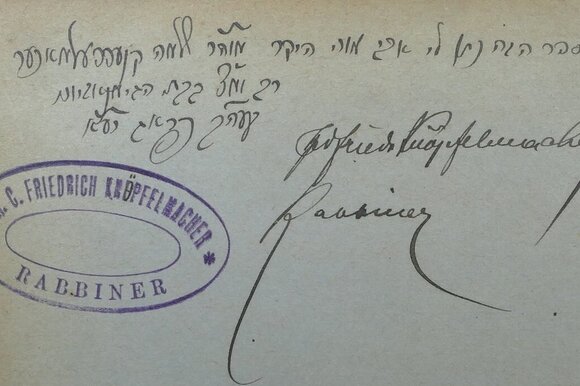
The project focuses on Hebrew-French glossaries, which are being edited (for the most part for the first time) and historically and philologically processed and contextualized because they are exceptional witnesses to a simultaneously developing (Jewish and Christian) French (Bible) reading culture in Western Europe between the 12th and 14th centuries. The glossaries form basic texts for research into the interrelations between Jewish intellectual history and the non-Jewish environment as well as the lexical interferences between Jewish and Christian vernacular cultures. The French glosses are written in Hebrew throughout and comprise about 1/4 of the Old French vocabulary known today.

From the outset, the philological work will be integrated into a digital working environment that uses the BIMA 2.0 database, which has been in productive use in the Corpus Masoreticum project since 2018 and is continuously being further developed. BIMA 2.0 ensures the editorial indexing and long-term archiving of all Hebrew-French material and provides tools that guarantee the sustainable management, processing, presentation and visualization of the project results. A data export interface via RDF/OntoLex ensures that the interoperability of the lexicographically relevant edition data is guaranteed as 'linked open data' with the resources of DEAFél(Dictionnaire étymologique de l'ancien français électronique), which are still available, and that DEAFél is therefore also used for further research. The field of Digital Humanities also makes an independent research contribution to the differentiation of a digital corpus linguistics of Judeo-French text cultures of the Middle Ages. The digital results will be supplemented by online and print publications that will provide new transdisciplinary academic impetus for Jewish studies, Romance studies, Jewish and Christian theology and medieval (knowledge) history as a whole.


Events

Student UnionOn-siteGerman
14 April 2026 18:00 - 21:00 UTC+02:00

A contemporary witness interview with Sophia Evalenko

Kabbalat ShabbatOn-siteGerman
24 April 2026 19:00 - 22:00 UTC+02:00

First Shabbat celebration of the summer semester

Past events

Festive colloquium in honor of Prof. Dr. Johannes Heil

News Special Dates

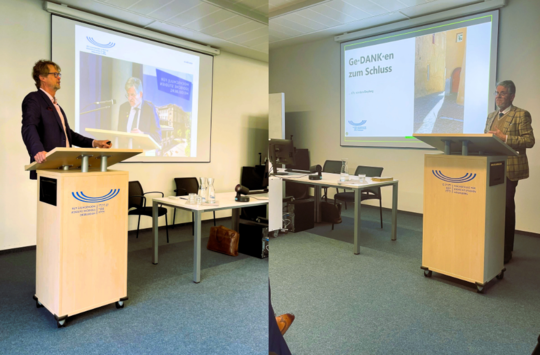
On 19 March 2026, a celebratory colloquium was held at the Heidelberg University of Jewish Studies (HfJS) in honor of Prof. Dr. Johannes Heil. Rector Dr. Andreas Brämer delivered his laudatory speech to over 50 invited guests, paying tribute to his impressive career - from his biography and academic highlights to his time as Rector and beyond.

Prof. Johannes Heil was born in 1961 in Frankfurt am Main, a city with a rich Jewish heritage. After graduating from high school, completing his civilian service and studying art history, classical archaeology, medieval and modern history and Jewish studies (including in Tel Aviv and Haifa), he received his doctorate in 1994 under Johannes Fried. He worked at the Jewish Museum Frankfurt, was a research assistant at the Center for Research on Anti-Semitism in Berlin and completed his habilitation at the TU Berlin in 2003. He has held the Ignatz Bubis Chair at the HfJS since 2005 and was co-opted by the University of Heidelberg in 2012.

Heil's research focuses on the history of European Jewry and anti-Semitism. His dissertation (1998) analyzes Pauline commentaries of the 9th century and their anti-Jewish constructions. His habilitation "Gottesfeinde - Menschenfeinde" (2006) uncovers the emergence of the Jewish conspiracy stereotype (13th-16th century). He recently published "Andere Juden" (2024), which sheds light on a "pre-rabbinic" Judaism in the western Mediterranean and highlights Jewish-Christian interdependencies. He is currently leading a DFG project on Jewish world heritage with Thomas Schmitt.

From 2008-2013 Heil was First Vice-Rector, from 2013 Rector of the HfJS until 2019 (with handover until 2020). He oversaw the new building, Bologna reform, accreditations and new degree courses, while continuing to teach. He positioned himself as socially relevant in debates such as Goldhagen and the circumcision ruling. As a "Mensch" (in the Yiddish sense of the word), he is committed to mentoring students and discreetly supports colleagues.

Heil remains active: a new research proposal has been submitted for review and he recently spoke at the Eugen Täubler Evening. The Rector thanks him for his influence on the HfJS and looks forward to further collaboration. עד מאה ועשרים - on his 65th birthday! 🎉
Festkolloquium für Johannes Heil
  • Date: 24 March 2026
    Date 24 March 2026
  • Time: 
	13:33
	UTC+01:00
    Time 13:33 UTC+01:00
  • Participation:
    Participation
  • Language:
    Language
  • Contact:
    Contact
  • Location:
    Location
  • Registration? No

News

Contact us

Logo Bibelglossare blau

Bible Glossaries

Show Contact List