

Theocracy versus empire: Eugen Täubler evening in Heidelberg
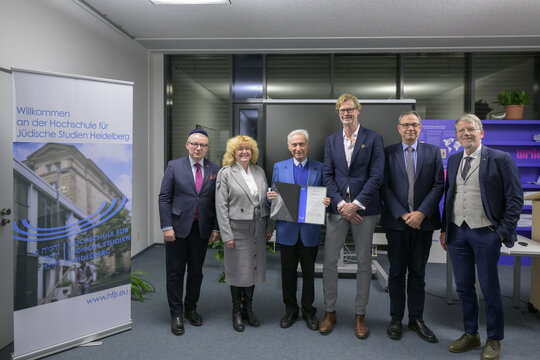
On December 17, the Heidelberg University of Jewish Studies united tradition and the present: Professor Kai Trampedach highlighted Jewish narratives against imperial claims to power in the Eugen Täubler Lecture, Salomon Korn was made an honorary senator and the fourth Hanukkah candle was lit - a clear signal for self-confident Jewish life.
In light of current events, the celebration of the day was a clarification, emphasized Andreas Brämer: "Jewish life in all its facets is at home here, we do not resign ourselves and take the space we deserve - visibly and naturally." According to Professor Heil, the Eugen Täubler lectures are steps towards breaking down the barrier between Jewish history and general classical history. The teaching cooperation between the University of Jewish Studies and the Department of Ancient History and Epigraphy has "opened up a lot of new ground" over the past three years. This cooperation should now be continued with Trampedach's lecture and in the future.
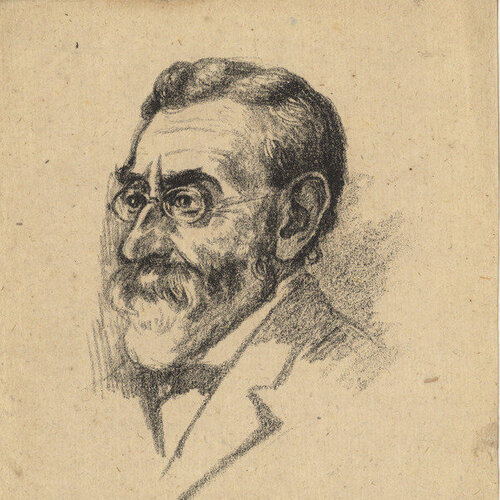
Kai Trampedach studied history, philosophy and Greek philology at the University of Würzburg and the Free University of Berlin and received his doctorate in ancient history and philosophy from the University of Freiburg. His research focuses on Greek history in the Classical and Hellenistic periods. Professor Heil's highly acclaimed contributions have focused on the time of Alexander the Great, Plato and his philosophy, and the Hasmonean rulers. His lecture "Alexander and the High Priest. On the discursive disempowerment of imperial rule in Jewish literature of the Hellenistic and Roman periods".
In his lecture, Trampedach primarily referred to a story by Flavius Josephus and used this example to demonstrate his Hellenistic narrative style and apologetic agenda.
At the center of Josephus' narrative was the alleged visit of Alexander the Great to Jerusalem. During the siege of Tyre, Alexander demanded support from the high priest Jaddus, who refused out of loyalty to Darius, the Persian king defeated by Alexander.
Angered, Alexander set off for Jerusalem to punish Jaddus. God appeared to the latter in a dream and promised his protection if he opened the gates and went to meet Alexander with all the people. Jaddus followed his instructions and indeed Alexander approached him, recognized in Jaddus the man who had also appeared to him in a dream and had encouraged him to go to Asia, and knelt before him.
According to Trampedach, however, this story is "fake history - invented from Alpha to Omega". Neither Alexander's trip to Jerusalem nor his prostration have been historically recorded. On the basis of several Judeocentric motifs, one could recognize that Josephus was the sole author of the story. Among other things, Trampedach mentioned the confirmation of Jewish rights by the respective rulers - an aspect that Josephus continues throughout his work - as well as the importance of the high priest as a contact person and representative of God. The superiority of Judaism is thus embedded in a historical framework and Judea is placed at the center of events. Theocracy is expressed in history through several aspects. On the one hand, God actively intervenes in history and places his people and his temple in the middle of world history. The covenant between God and Israel also obliges the people to observe divine commandments, while God grants Israel protection in return. According to Trampedach, this expression of theocracy is not just a literary invention of Josephus, but a long-standing feature of Israelite culture and the premise of almost all Jewish literature of the Hellenistic-Roman period.
Thus, the "discursive disempowerment of imperial rule" is nothing other than that theocracy. Historical events are not explained by inner-worldly causes, but understood as an expression of God's will, so that Alexander's rule appears like an unstoppable force of nature. The question of the reasons for his superiority, however, goes beyond the horizon of theocratic thinking - and cannot even be asked within it.
After this "digression into the Olympus of science", Barbara Traub took the floor to introduce the second part of the evening, the awarding of honorary senator status to Salomon Korn. She gave a laudatory speech that not only emphasized Korn's character, but also their long-standing friendship. Ms. Traub praised his courage, including when it came to taking a stand for the Jewish community in the light of anti-Jewish opinions, and credited Korn with playing an active role in shaping German society.
Salomon Korn was born on June 4, 1943 as the eldest of three brothers in the Lublin ghetto and spent the first years of his childhood in the DP camps of Berlin-Schlachtensee and Frankfurt-Zeilsheim. In view of this, Traub spoke of a childhood of "packed suitcases", as the family planned to emigrate to the USA or Israel. Against the backdrop of these existential uncertainties, his architectural studies can be seen as a desire to develop a solid foundation, a "drive towards the permanent". The fact that he had to deal with social processes and their abysses very early on can be seen in his sociology studies.
One contrast between the two areas is that society does not have one central master builder. Rather, it is a joint effort that we create, add to and question anew every day. Norms and moral values are crucial for society to really become a "community". Through Ignatz Bubis, Korn became involved in community work in Frankfurt in 1967 and, two decades later, understood how to intervene in the architecture of social discourse. Traub paid tribute to him as one of the "formative Jewish voices in Germany" and attributed the reorientation of the Hochschule für Jüdische Studien and its further development to Salomon Korn's early years on the Board of Trustees. She also honored the Heidelberg University Speeches initiated by Korn. His commitment to the university had established a bridge between Jewish scholarship and German society. She praised the university as a place of encounters where society becomes a living community.
Places that focus on community and a sense of security are extremely relevant, especially today. This claim is reflected in Korn's most famous sentence at the opening of the Frankfurt community center in 1986: "Those who build a house want to stay, and those who want to stay hope for security."
The concept of honor, Korn said after being made an honorary senator, is a serious matter in Judaism, linked to responsibility, dignity and respect. Accordingly, an honor obliges the recipient to work for the good of the community. The university is committed to the fight against ignorance and bias as a center of Jewish scholarship and acts as a bridge, systematically reaching out to the non-Jewish community. He concluded by expressing a wish, namely the completion of the shell of Jewish life in Germany: no police protection, no bulletproof glass, but strolling around in broad daylight with a kippah and Star of David. He wished that the Hochschule für Jüdische Studien would continue to provide intellectual and practical inspiration to promote and protect Jewish life in Germany and to intensify the dialog with the non-Jewish majority society. Following the Eugen Täubler lecture and the tribute to Salomon Korn, University Rabbi Janusz Pawelczyk-Kissin rounded off the evening in a reflective manner by lighting the fourth Hanukkah candle and opening the reception in the refectory.
(Editor: Annalena Bauer)
-
 Date 15 January 2026
 -
 Time 13:24 UTC+01:00
 -
 Participation
 -
 Language
 -
 Contact
 -
 Location
 -
Registration? No