

Kick-off event for the project "Media literacy in the context of the Middle East conflict"
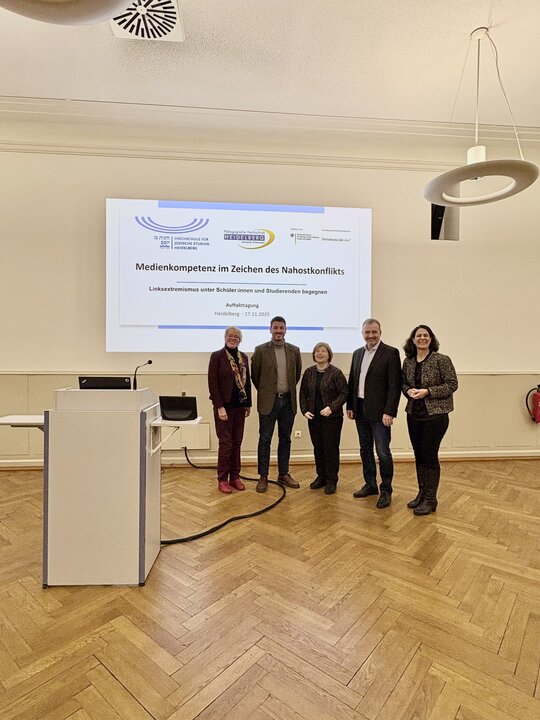
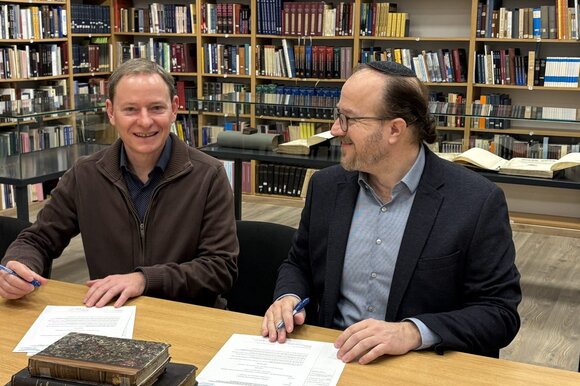
The project "Media literacy in the context of the Middle East conflict", led by Professor Havva Engin and Rabbi Professor Birgit Klein, was presented at the Heidelberg University of Education in November. On the one hand, the current relevance of the topic in the light of radicalized views regarding the Middle East conflict was discussed, but the project's approach was also explained in more detail. The final block of the event consisted of a discussion round with three guests and an exchange with the audience.
Tobias Doerfler, Dean of the University of Education, opened the event with a welcoming speech and directly addressed the aim of the project. Namely, "to sustainably strengthen the prevention of extremism and anti-Semitism in schools and universities and to further advance our education in democracy".
Andreas Brämer, Rector of the Hochschule für Jüdische Studien, also welcomed all those present. He noted that anti-Semitism had increased significantly in Heidelberg and surrounding cities since October 7. In a short space of time, more and more echo chambers had formed in which even young people were becoming radicalized, with social media playing a central role.
According to Brämer, teachers reported that they lacked the space and materials to convey the historical background to the conflict and to help young people make sense of all the information circulating. From all these aspects, he concluded that projects such as this one are needed, which use qualitative and quantitative methods to investigate the question of why the Middle East conflict has politicized and in some cases radicalized many young people.
Birgit Klein then took the floor. She repeatedly finds herself confronted with a blatant lack of knowledge about the history of the conflict and anti-Semitic stereotypes. In addition, the media is flooded with one-sided narratives. It is therefore important to take action against the distorted media portrayal by imparting knowledge and skills as early as possible so that misrepresentations are recognized and young people are given arguments to counter them.
Even before the project was presented, Havva Engin presented data on the use of social media by young people, thus creating a basis for shared knowledge.
A new JIM study showed that almost all young people between the ages of 12 and 19 own a smartphone and spend around four hours a day on it. A large part of their free time takes place in the digital space, especially on apps such as WhatsApp, Instagram, Snapchat and TikTok. "It has become an organ of ours, a part of young people's bodies too," Ms Engin summarized.
The study also showed that many young people have a keen interest in social and political issues. Especially in wars, the threat of war and conflicts. However, many are confronted with disinformation on a daily basis. Offensive comments and extremist political views, as well as other critical content, are also increasing rapidly. This should give us food for thought, especially because even very young people are coming into contact with it. Ms Engin emphasized that radicalization is a process that does not happen overnight and takes place in interaction with the real environment, i.e. a link between online and offline activities.
After a brief introduction by the research assistants Jessika Hoesel and Judith Damian as well as Lennart Koller and Andrea Setzer-Blonski, the methodology was presented.
A media diary will be used to record how young people consume and reflect on (left-wing) extremist narratives and content in the context of the Middle East conflict on social media. The target group are pupils aged 16 and over and students who will complete the diary over a period of two to a maximum of four weeks. The diary is intended to strengthen critical media and democratic discourse skills. Beforehand, an initial survey is carried out in which biographical data and media use are requested. One challenge is the fatigue when filling out the diary, also known as "diary fatigue", which manifests itself in the fact that participants fill out the diary more and more briefly and do not provide enough information. One solution to this is to fill out the diary multimodally.
Subsequent interviews focus on personal experiences, opinions and results in relation to the diary itself, but also with regard to the Middle East conflict. The aim here is to understand what role the Middle East conflict plays in the political opinion-forming of young people and to what extent social media are relevant in the process of politicization. Argumentation training and workshops will be developed based on the results of the media diaries and interviews. These are aimed at pupils and students on the one hand, but also at teachers, lecturers and other educational professionals on the other. The project is scheduled to begin in January, with workshops for teachers expected to start in spring 2027.
Patrick Baumgärtner (teacher), Argyri Parashaki-Schauer (Managing Director of LAKA Baden-Württemberg) and Norbert Pellens (Head of School) were also invited to take part in a round table discussion.
The discussion began with the question of the extent to which social media is responsible for contributing to radicalization, given the pronounced presence of social media in everyday school life. After 7 October, he spoke to 9th graders about this, according to Mr. Baumgärtner, and the communication was offen. Within two weeks, however, this had changed drastically: Some students expressed conspiracy theories and there were denials of the crimes of October 07. This false information mainly came from social media.
According to Ms. Parashaki-Schauer, in her work the topic of the Middle East conflict is always linked to her own experiences of discrimination.
It is interesting that young people immediately show solidarity. While there would be an outcry if Muslims as a whole were held responsible for the massacre on October 7, she often finds that this outcry and the demand for a differentiated view are missing when talking about the Jewish population with regard to the conflict.
Mr. Pellens also commented and highlighted another aspect, namely that it had taken a long time for the balance of reporting, including in the Tagesschau, to shift and for a more differentiated picture of the conflict to emerge. He did not want to blame the young people, he said. It was "exhausting" to remain curious, critical and reflective.
A student from the Elisabeth-von-Thadden-Schule in the audience explained that most students use social media extensively and therefore come across many posts on the Middle East conflict that they engage with. When Engin asked what they would rely on when it comes to recognizing fake news, one student replied that she searches the internet for more sources afterwards and talks to others about it if she cannot find any information.
Mr. Baumgärtner expressed the desire for spaces for exchange with students, such as social media consultation hours, where, for example, depictions of violence, Holocaust relativizations, but also unwanted pornographic depictions in the media can be discussed.
"We have a problem and must not ignore these problems in the school context," said Ms. Engin at the end of the event, "School makes society, school is society". It is also important to address these issues, to break new ground, to try out unfamiliar methods and to trust the young people to a certain extent.
In a concluding statement, Ms. Engin also noted that the format of the project combines theory with practice. For example, the survey uses scientific methods to determine the needs on the basis of which the materials can ultimately be developed. According to Ms. Engin, this is the strength of the project.
-
 Date 8 December 2025
 -
 Time 09:16 UTC+01:00
 -
 Participation
 -
 Language
 -
 Contact
 -
 Location
 -
Registration? No

![[Übersetzen nach: English]](/fileadmin/_processed_/4/9/csm_Judaephobia_9b7df4f2b0.jpeg "[Übersetzen nach: English]")